

How to Choose the Right Solar Freezer Capacity for Your Storage Needs
Oct 27, 2026
Leave a message
Choosing the right solar freezer capacity is important for keeping food and other frozen products organized while making practical use of available space and energy. A freezer that is too small may not meet daily storage needs, while an oversized unit may occupy unnecessary space and cost more to operate.
Before selecting a model, consider what you plan to store, how often the freezer will be opened, and how much frozen inventory you need to keep on hand.
1. Estimate Your Daily Storage Requirements
Start by identifying the products you need to freeze and the amount you expect to store at one time. A household with limited frozen food storage needs may be well served by a compact freezer, while a shop, restaurant, farm or remote supply station may require a larger capacity.
It is also useful to consider how frequently you restock. If you buy or produce frozen goods in batches, you may need more internal space than a user who stores smaller quantities and replenishes them regularly.
2. Consider the Available Installation Space
Capacity is only one part of the selection process. Check the freezer's external dimensions and leave enough room for installation, ventilation and routine cleaning, following the manufacturer's recommendations.
For off-grid installations, also consider where the solar panels will be placed and how the equipment will be connected to its power source. A suitable location should allow convenient access to the freezer while providing appropriate conditions for the refrigeration system.
3. Match Capacity to the Application
Different users have different storage requirements. Small households may prioritize a compact design, while convenience stores and food retailers may need additional space for frozen products. Farms, fishing operations and remote facilities may require larger units to handle seasonal production or less frequent deliveries.
Think about both your typical storage volume and your busiest periods. Choosing a capacity based only on average daily use may leave insufficient room during peak demand.
4. Check the Power Supply and Operating Conditions
A solar freezer's performance depends on more than its storage capacity. The refrigeration system, ambient temperature, insulation, door-opening frequency, solar input and available battery capacity can all affect operation.
Before purchasing, confirm the model's solar input requirements and compatibility with the planned power system. If the freezer will operate in an area with variable sunlight, check whether the specific model supports battery or grid backup and understand how its power supply is configured.
Avoid selecting a solar panel or battery solely by comparing the freezer's storage volume. The required system should be based on the actual equipment specifications, expected energy consumption, local sunlight conditions and desired operating time.
5. Compare Capacity Options Carefully
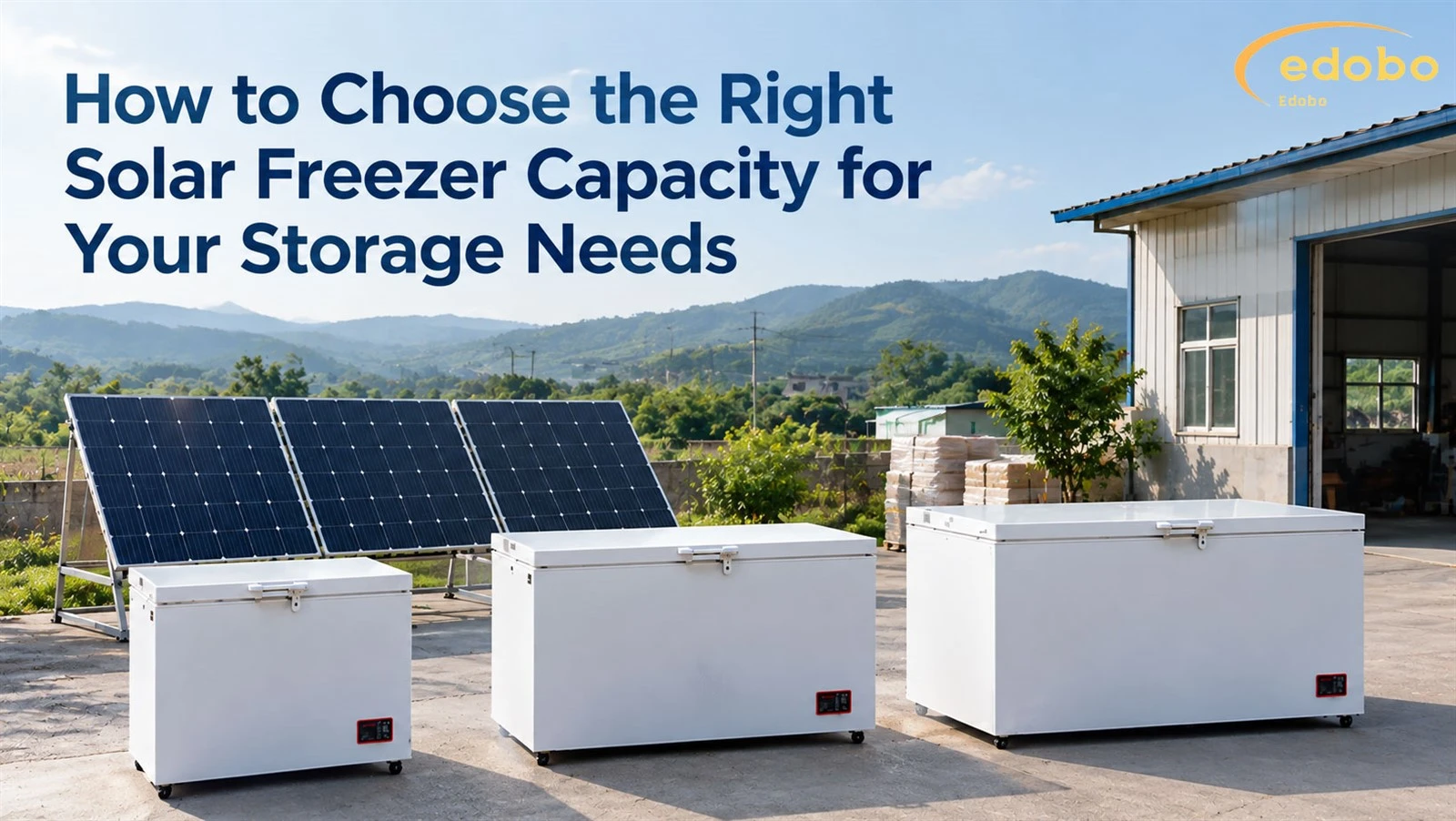
Edobo solar freezers are available in capacities ranging from 68L to 718L, providing options for different storage requirements. The most suitable model depends on the amount and type of goods being stored, the available installation space and the operating environment.
When comparing models, review the usable storage space, external dimensions, temperature range, power requirements and available backup options. These details provide a more useful basis for selection than capacity alone.
Choose for Your Actual Needs
The right solar freezer should provide enough room for your regular inventory without taking up more space than necessary. By evaluating storage volume, installation conditions and the complete power configuration together, buyers can make a more informed choice for household, commercial or off-grid applications.
Before finalizing a purchase, consult the specifications of the individual model to confirm that its capacity, temperature performance and power requirements match your intended use.
Explore Edobo solar freezer range to compare available capacities and find a model suited to your storage and power requirements.