Solar Panel Junction Box Crimping Machine
Description
Technical Parameters


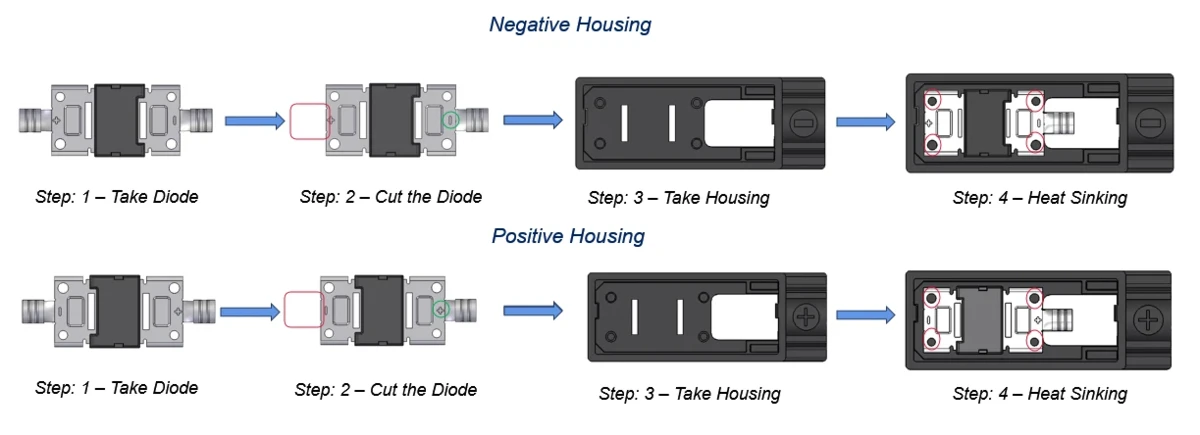
1.Take Diode:
An operator (or a pick-and-place machine in a semi-automated setup) retrieves a diode.
2.Cut the Diode:
The diode's leads (the metal wires extending from the diode body) are trimmed to the correct length. The image shows red outlines, possibly where the cut occurs. Precise cutting is crucial to ensure proper fit and electrical contact.
3.Take Housing:
The appropriate housing (either the "Negative Housing" or the "Positive Housing") is retrieved.
4.Heat Sinking:
The trimmed diode is inserted into the housing. The red circles likely indicate the contact points where the diode leads make electrical contact with metal parts within the housing. This step also provides heat sinking - transferring heat away from diode.

Polarity: The process is clearly separated into "Negative Housing" and "Positive Housing" steps, indicating that the diode's polarity (positive and negative terminals) is critical. The housings are designed differently to ensure the diode is inserted correctly.
Electrical Contact: The "Heat Sinking" step implies that the diode leads make firm electrical contact with conductive elements within the housing. This is essential for the junction box to function correctly.
Quality Control:
Visual inspection of the diodes before and after cutting.
Checking the diode's polarity.
Ensuring proper insertion and seating of the diode within the housing.
Potentially, electrical testing to verify the connection.
Further Assembly: This is just one part of the overall junction box assembly. After this diode integration, there would be further steps, such as:
Connecting the internal wiring.
Attaching the junction box to the solar panel.
Potting or sealing the junction box to protect it from the environment.
Adding cable glands or connectors.

Step 1: Take Diode:
A diode is retrieved (either manually or by an automated system).
Step 2: Take Housing:
The appropriate housing
Step 3: Heat / cold Sinking:
This step combines several actions:
Diode Insertion: The diode is inserted into the housing.
Electrical Connection: The diode's leads make contact with conductive elements within the housing.
Cutting: The diode's leads no longer need cutting.
Step 4: Laser Printing:
The housing is marked with identifying information (e.g., "ABC-A") using a laser printing/engraving system.
Step 5: Cover Plate Assembly:
The cover plate is attached to the housing, enclosing the internal components.
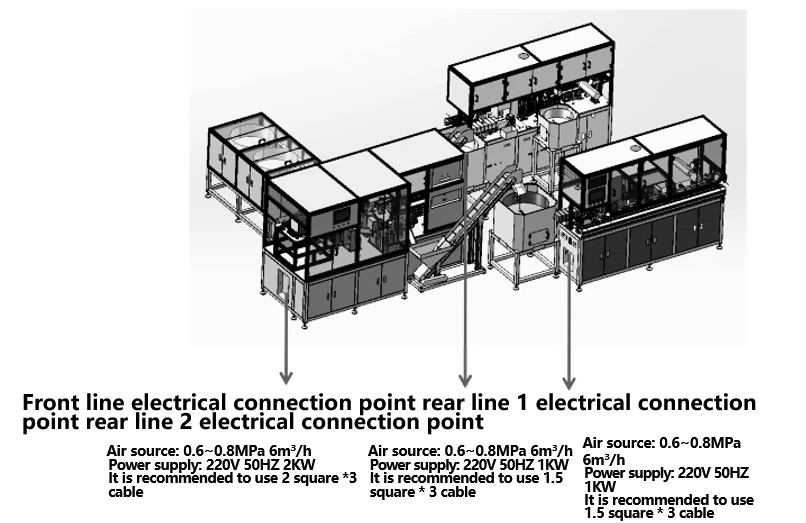
1. The raw materials required for the production of this equipment are: central negative box body and corresponding modules (tubes), pressure blocks, cables with connectors installed.
2. Function realization
① Automatic feeding of the central negative box body. Automatic feeding of the module. Assembly and riveting of the module with the box body. Electrical performance test of the intermediate body, coding. Automatic unloading.
② (positive and negative box body) manual cable riveting, automatic cable stripping, riveting (with pressure sensor), soldering, CCD visual inspection, automatic pressure block installation, automatic ultrasonic welding, automatic electrical performance testing, automatic coding, automatic unloading.
3. Equipment requirements
① All parts that come into contact with raw materials shall be polished to ensure that the surface of raw materials is not damaged, scratched or scraped.
② Ensure rivet wire compression ratio.
③ The ultrasonic welding of the sealing block has a bonding force of no less than 350 N
④ Electrical measurement and code data integration. ⑤C/T: 4 seconds.

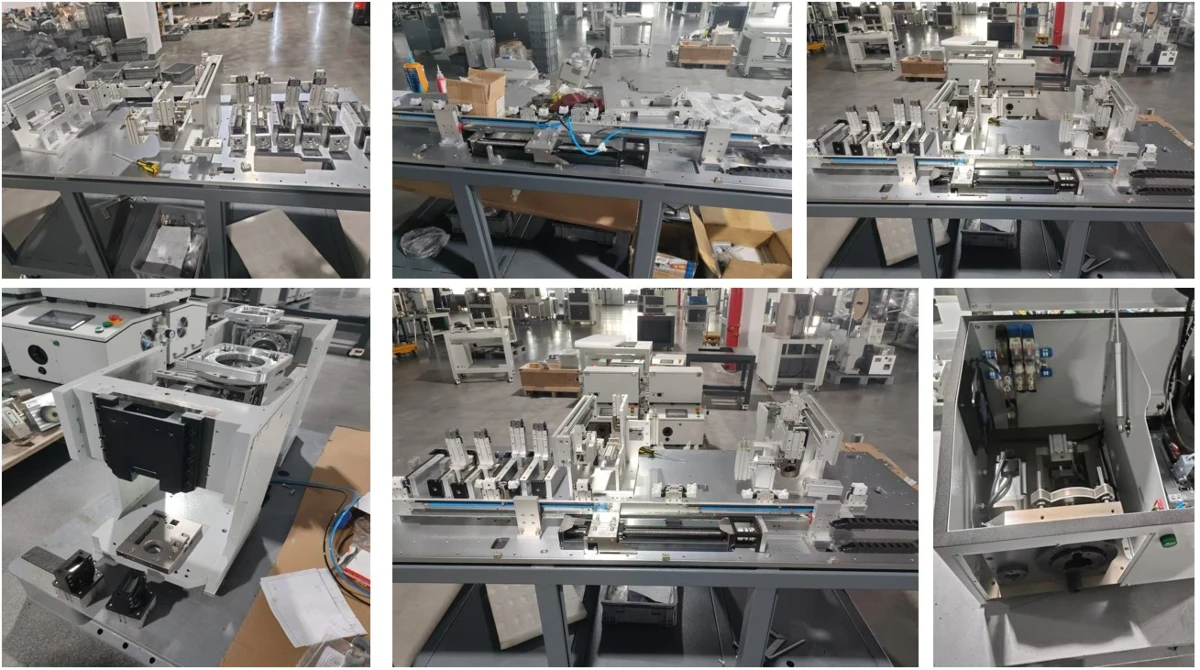

1. The production line is suitable for automated processing of photovoltaic cables. The production line flows from left to right and can achieve wire stripping, terminal crimping, CCD detection, connector threading, nut twisting, crimping junction box, CCD detection
2. Applicable wire diameter: 4mm²
3. Line length: 150mm-600mm, tolerance ± 0.002 * L+1mm;
4. Peel length range: 1-9mm;
5. Production rhythm: ≥ 4 seconds;
6. Host size: 1200 × 4000 × 2400mm
7. Human machine operating system: The touchable screen interface is simple and clear, allowing for quick control of the machine's operation. All parameters can be easily set and stored, and the operation instructions are displayed in an intuitive and simple manner through images. It comes with a 4-level password protection function (with permissions divided into operator, quality control, technician, and manager), a fault light, and fault code coordination for maintenance, achieving easy maintenance and cost reduction;
8. Most workstations use mature products for integration to ensure product stability;
9. Adopting servo motor control system to ensure product accuracy;
10. The program can store up to 100 files and can be accessed by selecting the program number. The database server collects production data and organizes quality for the production line, making it convenient for the upper system (MES or ERP) to extract data and trace processing data during product production through the network;


Hot Tags: solar panel junction box crimping machine, China solar panel junction box crimping machine suppliers, factory, Off Grid Solar Inverter 10kw, Solar Hybrid Power System, Solar Power Solar Panels, PV Power System, Portable Solar System, Off Grid Solar Power
Previous
No InformationSend Inquiry